Notes
How I Use AI
The basics of my AI use, summarized.
People ask what I actually do with AI day to day, beyond typing questions into a chat box. Two things, mostly: I build with documents that give the AI context to work from, and I've been thinking a lot about what all of this means for how I write.
Document-driven workflows
I went to an AI workshop for product managers during Philly Tech Week, and I saw how they had come together to form a group to convert their typical product management workflow into a template document they could use to seed new projects. The pm-toolkit they shared was a huge unlock for me. It helped me get my build ideas down "on paper" so I could hop in and out of projects more easily.
With this toolkit, I started using the CLI and my file system much more readily, because it helped me be better able to see what folders the AI had access to and what sandbox I was operating in, and it felt more intuitive to switch back and forth among different CLI windows.
It helped me understand that I could write instructions to the sandbox for how I wanted the output to look (design.md), specific tasks (skills.md), and rules for how to interact with the LLM (agents.md). This helped me build context, providing the LLM with clear, scoped information to work from. I don't take credit for this repo, though I did modify it to suit my needs; feel free to do the same for yourself.
AI in writing
I am living for the discourse on AI and writing. Writing, and art, and communication generally, has been a bit looked down on in tech circles, and now suddenly everyone's worried about protecting it and pining for the good old days. I remember my engineering classmates moaning about their required writing courses; my how the turned tables. Interestingly, a lot of my favorite people on LinkedIn have entered the chat on this topic.
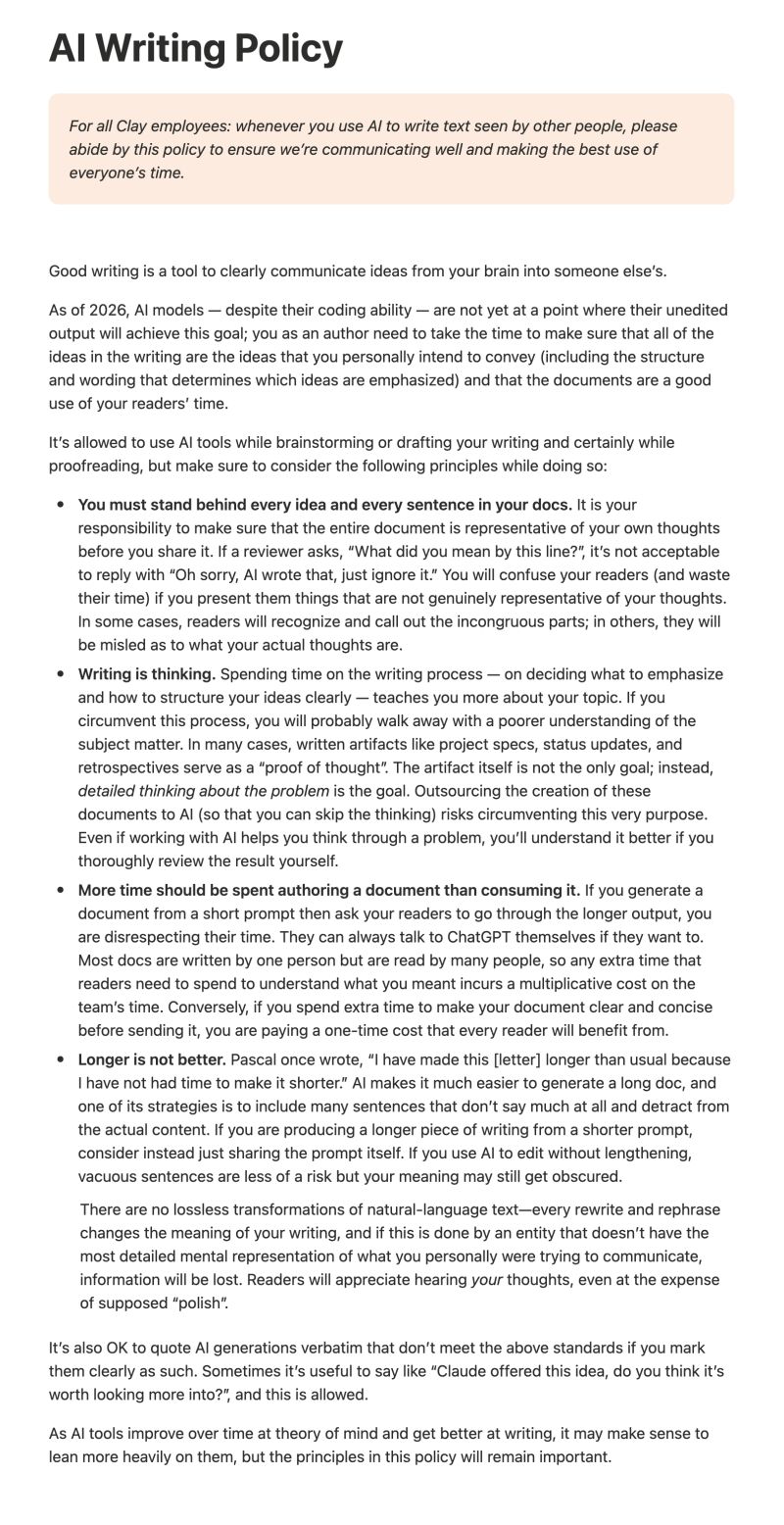
On one of my favorite podcasts, The Curiosity Shop, the takeaway from a recent episode boiled down to this: communicate your expectations about AI use in writing with your team, up front. Then I saw recently that Clay had created an AI Writing Policy document, which I thought was a fantastic manifestation of what had been discussed on the pod.
It seems to me AI has given us a reason to value critical thinking again, and to appreciate people who actually practice writing, or who share what's going on in their heads with real clarity. I'm curious where this goes. I'm hopeful AI might lower the barrier for people to actually share their thoughts (voice notes have helped me a little with my own perfectionism), and that it might make us appreciate art, and each other's minds, even more.
Writing this made me think I should probably have my own rules and expectations for how I use AI in my writing:
- Get it out. Use the tools (voice notes, transcripts, dictation, grammar editing, feedback mechanisms) to exorcise your thoughts from your system.
- Editing is most of the work. You have the raw material. What is it trying to tell you? Carve until you find it, then let the rest go.
- Write for your friends. The old ones and the ones you haven't met yet.
- Be considerate. It takes far more energy to refute nonsense than to produce it. Do the work so your reader doesn't have to.
That's the shape of it, at least for now. I look forward to continuing to collaborate with folks and update as things evolve.